Thursday, January 10, 2013

Our Generous Hosts: Hospitality in the Arab World

The fact that Arab people are characteristically hospitable is probably not news, even to readers completely unaware of Islamic culture, but I will write this post to reaffirm this understanding and further apply it to Saudi Arabia.
Even in the US at Troy, I received numerous invitations to Saudi homes upon their learning that I spoke a little Arabic and generally cared about other cultures, so I knew that our group would be treated very well on our visit.  However, my own expectations were blown away and I received more invitations and gifts than I ever expected.  Though each present and offer was unique and very appreciated, I'm just going to list everything I can remember.

  • At each school we attended, we left with books, pens, keychains, mugs, and bags.  Just about all of this free university propaganda was well made and likely expensive to produce, making it impressive that the schools dolled out this stuff on American students that will, in reality, never attend their universities.  
  • At a few schools, the gifts were extra-impressive, even if they were only given to the boys.  The girls were rather unhappy that, on two occasions, the boys received briefcases from schools that only gave us a pen and a pile of brochures.  Male and female campuses operate mostly independently, and it's not surprising that male visitors were treated a little bit better, and it's still impressive that the schools were willing to spend so much on their visitors.
  • A quick picture with King Abdullah at the female campus of Al Saud University
    the ladies giving us a tour were uncovered, so I couldn't post any pics of them
  • The universities themselves made great efforts planning our visits.  At the female campus of Al Saud, we were shown around by an absolute army of PR women and many schools hosted us in huge board rooms with individuals in the highest levels of leadership. 

PMU_2700.JPG
An example of a swanky boardroom afforded to our
NCUSAR visit, this one at PMU
  • Many meetings included small delegations of students to show us around and answer questions even though it was exam time and those couple hours were extremely precious.
  • Every single meeting everywhere included multiple opportunities to drink Arabic coffee, the symbol of Saudi hospitality, accompanied by dates and usually some sort of pastries or hors d'oeuvres.  The coffee and food was served immediately once we sat down, usually by a Filipino servant the same gender as our hosts, but sometimes by the lowest ranking individual among our hosts.  
  • At hotels, we were served fresh smoothies, called "cocktails" in the dry country of Saudi Arabia, while we waited for our room keys to be programmed.
  • Doors were readily opened and bags carried, if you protested, there would be trouble; then, you would hand over your stuff and let the favor be completed.  I'm sure that our male colleagues received only a slightly toned-down variety of this chivalry.  
  • Our Saudi guides from the Ministry of Education, Saad and Sultan, paid out of their own pockets for a number of things for the group.  This included a few souvenirs and a whole day of boating on the Red Sea for the entire group.  (I"ll post pictures from that day in my next post.)
  • Saad and Sultan also volunteered their time, patience, and expertise to our own shopping goals.  Sultan spent an entire evening with the girls while we shopped for new abayas in Khobar.  We walked about a half mile to find a spot with the best stores, and he helped each of us find abayas that were relatively fashionable and fairly priced.  There’s a surprising amount of variety available when purchasing these black, unflattering dresses.  He was quick to point out that the abaya I was eyeing was of an old fashioned cut or style.  He also frequently criticized my selections as being too plain.  Once I selected one I liked, Sultan carried it up to the salesman for the fiercest haggling I’ve ever seen.  He gave this attention to each of the girls purchasing abayas that evening.  Saad was equally dedicated to our shopping success when we went to the old souk in Jeddah and gold shopping in Riyadh.  Although the chaos of the old souk didn’t really appeal to such a classy guy, he still bargained for our spices, scarves, perfumes, and trinkets like he was paying with his own money.  Saad ended up also being a gold expert, giving us lessons on quality and then helping us select and barter for our own pieces in the markets of Riyadh. 
  • Both Saad and Sultan also picked up a few small items for the girls they were shopping with.  Sultan was extra happy to buy a recording of sung Koranic verses for the opera singer/Middle East expert in our group who also blogs at http://kayleetosaudi.blogspot.com/.
  • I was at an advantage in the Kingdom because I already had a few friends living there.  When I was In Riyadh, a friend from Troy came to our hotel for dinner with us and then returned to give everyone in the group a little souvenir before we went home.  Another friend from Dammam dealt with my crazy schedule to pick me up, introduce me to his family, and then take me and another girl from our group, Khadija, out to eat with his sister and cousins.  Even the people we had just met went out of their way to visit us and take us out.  One new acquaintance even picked me up from the hotel to go out to the cafe at the Ritz Carlton with his cousin (it seems that cousins are always free for such things) and gave a first-hand lesson on covert fun in Saudi Arabia.  As in America, it is near impossible to convince your hosts to allow you to pay for your own food. 
  • In addition to our own planned tour, the one Muslim student in the group, Khadija, was taken on hajj to Mecca, a once in a lifetime opportunity that, to my knowledge, cost her nothing.
  • Everyone we met freely gave business cards, contact information, and Facebook friendships for networking and potential future visits.
  • Our visits were included in school newsletters and web posts, like this one from PMU http://www.alsharq.net.sa/2013/01/09/667205.
  • When we visited the Jubail Industrial City’s Royal Commission for Planning, we were privileged to a day-long tour, lectures, and a reception/lunch with Commission members and faculty from the university associated with the city.  The visit to Jubail ended with the best gifts we’d gotten thus far: traditional tagias, gutras, and igals for the boys, framed traditional Saudi jewelry for the girls, a framed picture of the group and the city lit up at night, and a CD of all the photos taken throughout the day.
  • When we visited the Nafissa Shams Academy for the Arts and Crafts, a training academy and production facility for Saudi women in Jeddah that specializes in traditional and Islamic handicrafts, we were greeted with spectacular warmth from our hosts, great prices on the few items that were for sale in their shop, and a beautiful set of prayer beads for each visitor.
  • We each received many invitations to dinner at private Saudi homes either as a group or through our own personal contacts.  Unfortunately, the only of these offers we were able to take up was the meal at Dr. Mody’s home, which was amazing and definitely worth waiting for until our last night.  
  • We also received many invitations for trips to the desert or cultural destinations that we were unable to accept based on our schedules.  For future trips, it might be helpful if the Ministry guides allowed a few of these visits, giving us the opportunity to experience Saudi Arabia through someone else's perspective and giving them a short break from a trip that is otherwise pretty demanding.
  • The wait staff at every hotel we visited treated us loud Americans like royalty.
  • One or two universities gave us the use of their buses for our travel while in their cities.
  • Though not quite in the vein of "hospitality," Saudis dolled out compliments, especially to the ladies in our group, very frequently.
Although this is an exhaustive list, it's not even near complete, but it hopefully solidifies your understanding of Arab hospitality, as experienced by a group of 10 American students and 2 NCUSAR leaders while on a brief visit to Saudi Arabia.  


How Saudi Arabia Turned Me Into a Girly-Girl


My ten day trip in Saudi Arabia of course changed the way I think, but it also changed the way I act.  From the time I took to get ready to the way I held my purse, I was behaving just a little bit different while in the Kingdom, and it’s taking me some time to revert to my more natural habits.

I would say that my most defining physical feature is my hair, and with that tucked under a hijab all day, I picked up the desire to put too much effort into my make-up.  My skin was very dry at the start of the trip, so I picked up some fantastic Nivea moisturizer and packed on the Bare Minerals foundation for the first time, and then I wielded my eye-liner pencil with a similar fierceness as most Arab women, to whom we owe credit for the pain in the ass invention in the first place.
After having spent much time mastering my own hijab-tying method, I felt the very
pretentious desire to show it off and took lots of pictures
I didn't only get girlier by caring about my looks a bit more.  The hijab requires the wearer to turn her shoulders and torso with head to spy anything outside her further limited peripheral vision.  This movement results in slightly better posture and a more elegant and prissy appearance.  An abaya that is too long (so any abaya) requires either high heels or marked sashaying to keep the bottom hem clean.  The long sleeves require the wearer to raiser her hands, maybe clasping them together in front of herself, to keep her hands from being lost in the folds of black fabric.

Abaya shopping in Khobar with the girls and our  fashion-savvy guide, Sultan
Personally, I try and complete the same actions needed for life as men: opening doors, serving food, or carrying heavy things.  However, when my primary focus shifted from self-sufficiency to avoiding tripping and falling on my face, I waited as car doors were opened for me, my food was dished up, or one of our guides offered to carry my briefcase for the billionth time.  I accidentally took this a step further by purchasing an abaya with beading on the shoulders, making it unwise to carry an across-the-body bag and forcing me to carry my purse in the crook of my arm like a straight-up diva.

While these little changes are humorous to me, the passing tourist, I cannot imagine a whole life where even the simplest tasked seem to be aimed at increasing my poise or relying on a man’s help.  Maybe the restrictions on women travelling alone are based on the fear that Saudi women would trip over themselves, landing in heaps at the bases of airport escalators due to not having their men at the ready to carry their things while abayas are held out of harm’s way. 

Wednesday, January 9, 2013

Day 12: Refocused Attention on Racism in the US


I am currently writing this on the plane from Doha, Qatar back to Dulles, VA.  My 10-day trip has felt more like a month-long trip, leaving me exhausted and overwhelmed.  I have grown incredibly attached to the people I met through this visit and it feels strange that they aren't accompanying me to Dubai.  Although we did so much this trip, I have yet to even mention 75% of it on this blog, and there are still aspects of Saudi society I know I haven't seen.  The visit lacked study of tribes, minorities, the poor, and the counter-cultures that are present in the KSA.  For this reason, I'm considering using my 90-day visa to return to the Kingdom for some follow-up research.  This is something I'll decide on later though because I might find that Dubai holds even more mysteries than Saudi Arabia.
Our final meal in Saudi Arabia, served at  Dr. Mody's house, traditional -style on the floor

Before leaving Dr. Mody's to pack and fly back home
I am anxious to return to Troy University and begin implementing my projects associated with my post-visit year-long fellowship.  I had my own ideas about how I could help Americans understand Arabs, specifically Saudis, but my course of action has changed slightly.  On our last night in Riyadh, we ate an amazing traditional dinner at the home of Dr. Mody, who we know from the Saudi Cultural Mission to the US in Virginia.  After dinner, she gave some insight into why Troy University was losing so many of its Saudi students.  The lack of a very challenging curriculum was one factor I expected, but she also said that some of our Saudi students experienced so much racism that they want to avoid the South all together.  This really scared be because I thought that our international students were better protected from the harsh, often racist, views I've become familiar with.  I am embarrassed by my culture and my school.  In order to try and combat this, I may host a workshop for incoming Arabs on dealing with racism and ignorance.  Our Saudis are proud of their beliefs, but likely have had few reasons to defend them in the fact of opposition before coming to Alabama.  I would need extra help reaching out to Saudi women in Troy, who stand out so harshly in abayas and niqabs in the Bible Belt of the US.  I also want to bring in other Arab students who have successfully adjusted to life at Troy without abandoning their own cultures.  I don't really have experience in dealing with racism.  It's definitely present in my area, particularly where I went to middle school; I also have felt sexism since coming to Alabama, but I have never been mistreated in public places like grocery stores or school offices because of my heritage, and I'll have to work to remain realistic when trying to combat racism from the side of the victim.

Of course, I also want to work with Americans, since it is not the fault of the Arab students that they are met with hate.  This might include talks with church groups, joint events with my school's Saudi Student Association, and maybe even some beginner Arabic lessons I could start off.

I don't think that my enthusiasm for these projects will wain because it attacks a problem that I've been witnessing for years; it is also obviously significant to the NCUSAR and Saudi government, or they wouldn't have invested so much into our trip.

I have more to write about my experiences in Saudi Arabia, but I just wanted to give you an idea of the bigger picture of the visit as this fantastic trip concludes.

Monday, January 7, 2013

Women in Saudi Universities

During our visit to Saudi Arabia, we have visited most of the prominent universities in the Kingdom (the greatest exceptions being Dammam University and Queen Noor University in Riyadh).  These have included male universities, female universities, and campuses that accommodate both.  The campuses that accept both males and females had two separate and identical campuses for each gender, except for Al Faisal University in Riyadh.  Women had access to near exact replicas of the buildings and facilities in the men’s sections.  The situation regarding mixed gender professors differed.  At some universities, men and women did not mix at all.  At others, there were one-way screens that allowed women to see their male professor, but the professor could not see his female students.  In schools with this set-up, like Prince Mohammad University in Dammam, women could not teach men.  Al Faisal University has taken the most progressive steps toward mixed gender education we saw.  The Al Faisal buildings each had four floors.  Floors 1 and 2 were for male students, and floors 3 and 4 were for female students.  The lecture halls were situated on the 2nd and 3rd floors so that teachers could see all of their students.  This construction allowed male and female students to even communicate with each other during class discussions.
A lecture hall at Al Faisal

King Faisal's Palace, in the center of Al Faisal Unviersity

A lot of these schools love symbolic motifs, Al Faisal has key holes

An example of a one-way screen in women's classes at some universities

The reaches of King Fahad campus

King Fahad Research Center
Among Saudis, it is firmly believed that men and women learn and think differently, so everyone I asked had an opinion on gender mixing in the classroom.  Some people, including the female faculty and staff at both Prince Mohammed University and Al Faisal and males at other universities believed it was important to learn with the opposite sex in order to see new perspectives on issues and prepare for potentially mixed workplaces.  However, some of the women studying at segregated campuses said that the differences in learning styles inhibited success in the classroom.  One girl at Prince Sultan University in Riyadh said that she would never want to learn in the same room as men because women tend to intuitively understand some concepts quicker and men slowed the process by asking too many questions.  I found few, however, that appreciated being only taught by one gender, or sitting in a room where the professor could not see them. 

Having spent all of this time in universities touring facilities, hearing from professors, and questioning students, I have of course developed my own opinions shaped by my own experiences and this trip.  I understand and sympathize with the argument that men and women learn differently.  Even in the US, where genderization is far less pronounced than in the Kingdom, I have seen that collectively, girls learn differently than boys, especially in the elementary and middle school years.  However, these differences are tempered and utilized once students reach high school and college.  In group discussions, especially in literature and political theory, I cannot imagine a well-rounded discussion that lacks representation from half of the world’s population.  (Maybe in more technical courses, this is less of an issue.)  Also, by competing for grades with female students, males will be forced to recognize intelligence and capability in women, the first step to granting equality in the workplace and society.  

In some areas, I completely appreciated gender-separate facilities, like within female gyms and swimming pools, but having entire campuses and staff duplicated is costing universities millions, and with all of the current development of the higher education sector and massive scholarship programs for students, universities should follow more sustainable models, like those I saw at Al Faisal.  King Al Saud in Riyadh and King Abdulaziz University in Jeddah seemed to have the largest separate facilities, with sprawling gardens and huge medical research facilities for each gender. 

The women of our own group have gotten more unwanted attention from men here than they would in the states.  The harassment was at its greatest in airports and low-end shopping districts, but it was also present on all-male sections of universities.  I remember some disconcerting stares at Prince Sultan University, and a few of us were even sung to while passing by male students at Prince Mohammad University as we crossed over to the female campus.  When we toured classes and saw men in a more professional setting, the ladies were clearly a novelty, but they were in no way disrespected.  At Al Faisal, however, the male students were models of respectability.  I even tried a few of the faces I’d learned at the airport to see if I could illicit a response—Nothing.  It was clear to me that the men of Al Faisal were the most prepared to work abroad or in a mixed gender setting in SA.  Unfortunately, we didn't have time to speak to any of the women studying at Al Faisal to get their take on the matter.

At our visits to one-gender schools, like King Fahad University of Petroleum and Minerals in Khobar and Dar Al Hekma in Jeddah, the experience was no different from a visit to an all male or all female school in the United States. 

Another important topic about gender and higher education is the availability of majors to each sex.  It is clear that Saudi society values gender roles and Saudi universities have taken small steps to alter conceptions of ability to perform a job based on gender (I’ll include my personal thoughts on this below).  While Saudi schools are at the cutting edge of education in medicine, engineering, and the hard sciences, women have, in many cases, been left out of this development.  On most of our visits, after praising their school’s international accreditation in the fields of sciences and all of the possibilities for engineering student job placement, the PR man would inform us of the great programs for women in interior design or child psychology.  (I can say that none of the American visitors shares the universities’ enthusiasm for either of these subjects after hearing that other majors are off-limits to women and that men couldn't pursue such fields either.)  Now I do not doubt that just about all of these women are perfectly happy with their selection of majors, and they’ll become fantastic new media specialists and designers, but it is unfortunate that they are not given the choice to study the same subjects as men.  There were some inspiring exceptions to this limitation, such as the women’s law program at Prince Mohammad University and the science departments at a few other schools. While some schools had great science and medicine programs offered to women, the added cost of separate facilities made this accomplishment seem hollow and unsustainable.

Now, this may seem a criticism of Saudi higher education, but all of these practices that seem so different from our own American values must be viewed in light of Saudi Arabia’s societal structure.  Saudi society has actually made major leaps in the past 20 years regarding women.  Changes can be viewed with every graduating class of women leaving their Saudi universities to go work, receive further education, or chose to begin family life.  University education for women is no longer just an appeasement process with no meaning; women graduating from Saudi schools are prepared to work anywhere in the world, except in many cases their own country.  The women of Dar Al Hekma, to which I would like to dedicate a post to later, are the best examples of educated and ambitious young Saudi women I have seen.  The Saudi system for girls is very different, but I could also see myself studying alongside them, building friendships and skills without romantic distractions.  I do believe greater balance is necessary in Saudi female life, and so I will also talk about the Saudi women’s chamber of commerce, the Al Sayedah Khadijah Bint Khawilid Business Centre, inshah allah once I get some free time.

I am thankful for the hospitality shown by the schools we toured and I expect to see greater accomplishments for Saudi women in higher education because their ambition and optimism is so limitless.  And with that, our plane is now landing in Riyadh for our final night in the KSA.

Friday, January 4, 2013

Things Saudis Like

Here is a tentative list of things in no particular order that I suspected Saudi's liked before, only to be reaffirmed by this visit:

1) picnicking
2) Rihanna
3) napping
4) playing their music too loud, especially if it's Rihanna

Some Thoughts on Historical Sites in Saudi Arabia

Just as a note, I doubt that many of my other posts until the end of this trip will be very chronological, and I'll try and work more on themes rather than days.  This also will allow me to skip talking about things I'm not really informed of or don't really care about without as much guilt.

Anyway, historical buildings and stuff...

When driving [or sitting as a passenger if you're an apathetic female reader] through Riyadh, you are surrounded by futuristic and opulent architecture.  You can really understand frequent Saudi boasts about the modernity and development of infrastructure in the Kingdom.  Oil wealth is funding the Al Saud ambitions of presenting a new image of Arabia and a rival to other up-and-coming Gulf cities like Dubai, Abu Dhabi, Doha, and Manama.  However, this development has costed and characterized the appreciation and understanding of Saudi Arabian history.  You will see no historical buildings around town, quite unlike the typical Western capital that always has some throw-back to the early history of the city.  In Saudi Arabia, it seems that people have no interest in the land's incredibly rich history, especially that which predates King Abdulaziz (the first king of Saudi Arabia, also called Ibn Saud...I can explain the parts of an Arabic name later maybe).

In Riyadh, the two exceptions to this rule that I got to see are Musmak Palace and Old Dir'aiyah.  Musmak is a palace/fort in Riyadh.  It is the fortress that Abdulaziz (Ibn Saud) took to solidify his hold on Riyadh.
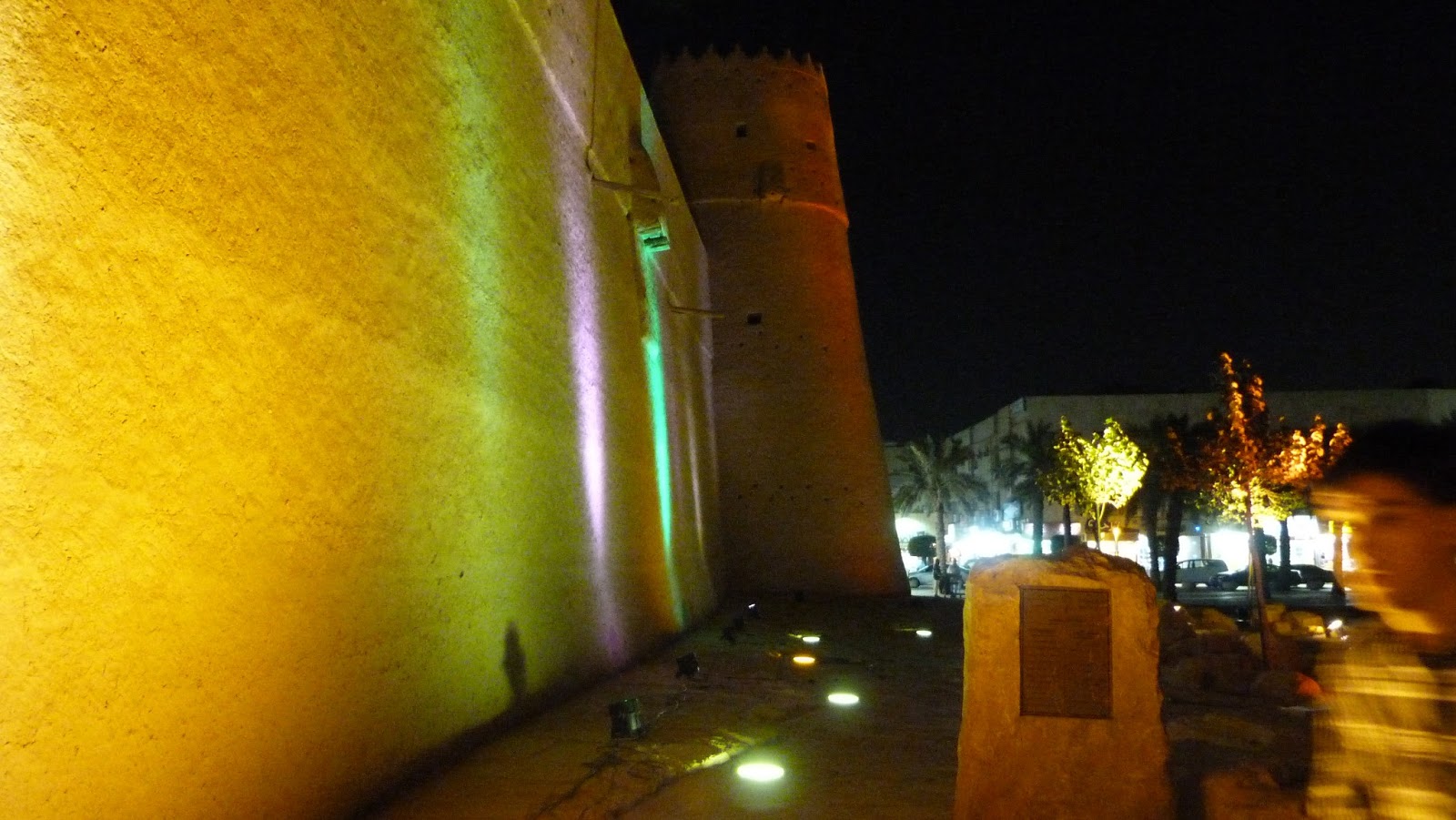
Colored lights on Musmak Palace
How Ibn Saud unified Arabia after conquering Riyadh

The museum included many weapons related
to the taking of Musmak Palace and
anything that generally made Ibn Saud look good

We arrived at night to find colored lights flashing on the facade of rough stone.  The lights and the amount of people milling around made the fort look like a themed section of Disney World.  The museum inside was open, and we were led on through to see generally self explanatory and expected exhibits of weapons and traditional Arabian crafts.

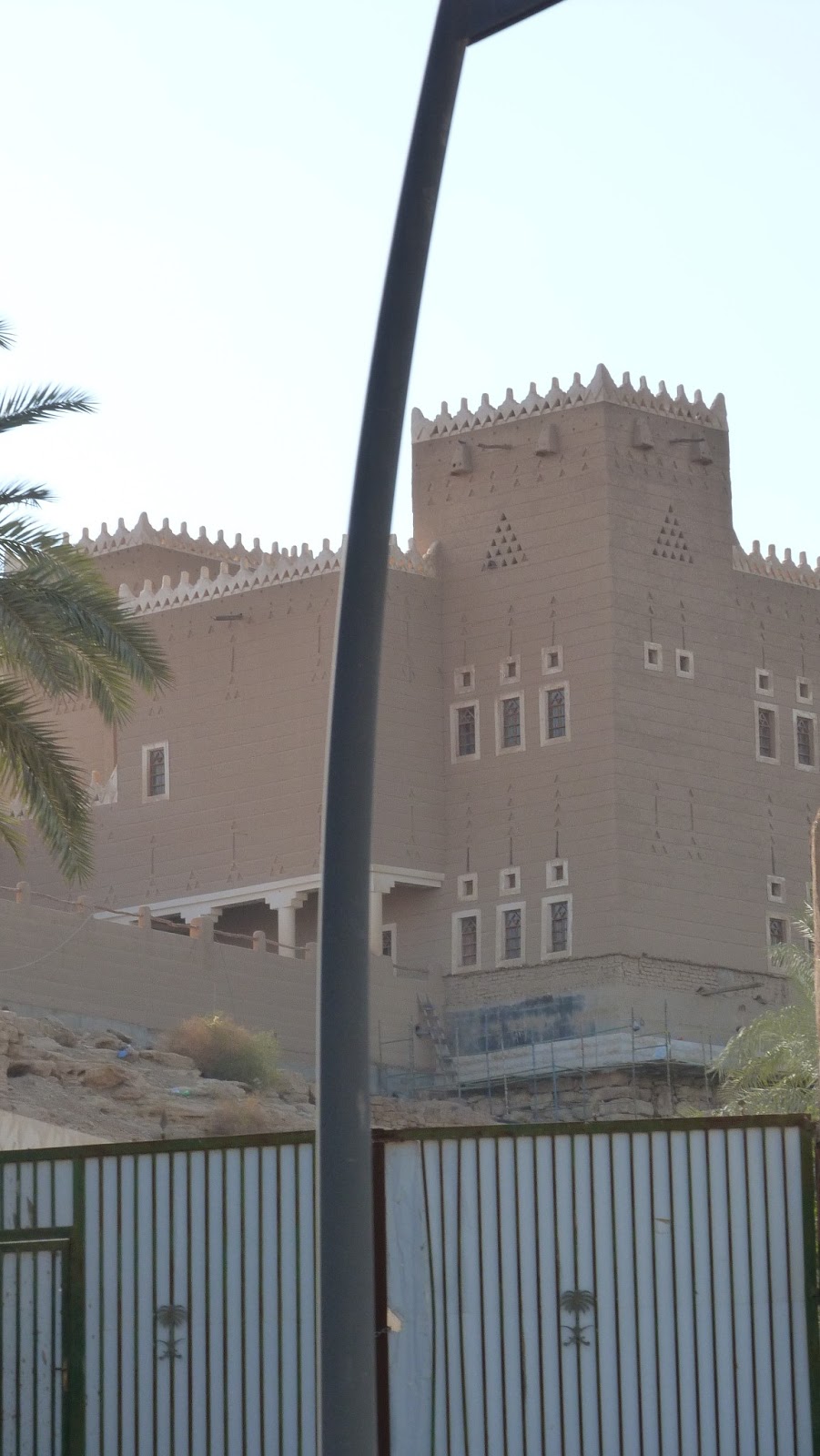
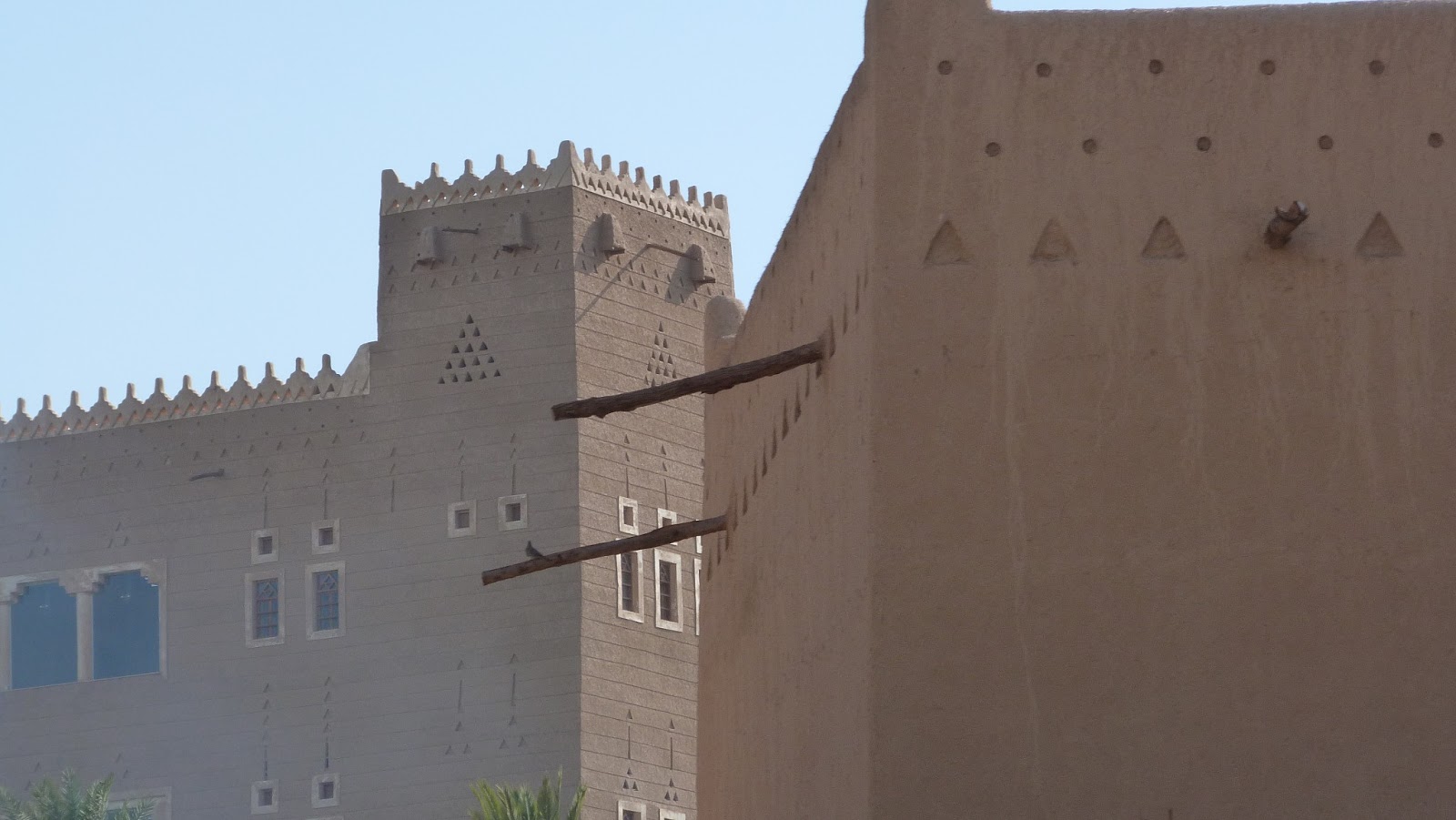
Another historical site in Riyadh is Old Dir'Aiyah, which is a section of NW Riyadh where you can still see buildings like those so romanticized in films and literature.  Old Dir'Aiyah consists of old palaces and houses in various states of both decay and restoration.  The restoration work is currently under way and construction equipment in the area made our bus ride rather tricky.  I'd like to revisit the area in a few years when the trucks have rolled out and the buildings are open to the public.


Riyadh seems it can erect modern architectural masterpieces much quicker than it can complete restoration work, though that is certainly understandable.  I wonder if, when completed, these restored areas that seem so akin to the restored areas of American cities like Williamsburg, VA will have admission fees or not.

Tonight, I am in Jeddah and am again in awe at the modernity, traffic, and cosmopolitan lifestyle here.  The group did get a bit of culture in Jeddah's beloved old souks.  The buildings housing stalls of prayer beads and spices certainly give a feeling of being in a different time, but the prevalence of clearly Westernized items, mostly cheap knock-offs, detract from the beauty of the experience, though I feel the permeating odor is somewhat similar to that experienced by camel traders of yore.

There are of course many historical sites that are simply not in my 10-day program as planned by the Ministry of Education in Saudi Arabia.  The holy cities of Mecca and Medina house sites most relevant to Muslims, but also to Christians and Jews also descended from Abraham.  Unfortunately, Mecca and Medina are off-limits to non-Muslims and so visitors cannot view the Kabba or the beautiful Masjid Nabawi.  Also not on the program was Medain Saleh and the famous Al Hijr archaeological site, of course we also will not see the various lesser archaeological sites present in the Kingdom either.  I think that a visit to these sites would have altered my conceptions of how Saudi's view their history.  Similarly, I believe that spending some time in the desert would leave the traveler feeling more tied to Arabia's ancient roots than touring major cities would.  I'm certainly not complaining--just saying that I may feel differently about this idea were I to see more of the Kingdom.

While I love the city life, development, and optimism in KSA, I'm finding myself nostalgic for a time I never experienced in this place I've never been to before.  When questioned about misconceptions I had about KSA before coming, I don't include this idea because I was already pretty aware of the cultural situation here.  Saudi cities don't center on their own histories like American cities often do; they are much more concerned about the future and ancient ideas clogging up their goals.  I do hope that, on this trip or any future visits to the Kingdom, I find a place that, to use a perturbing phrase, looks to its future without forgetting its past.  I think I could find places like this in the Eastern Province or maybe in the north and south, and though we won't be taken there on this visit, maybe on a future trip, I'll find that ideal city that can progress while allowing its people to remember their history through some architecture and infrastructure.


Tuesday, January 1, 2013

Day: 4? Maybe?

Some Arabic tea while dining with the ambassador, photo credit to Mohammed, http://malashri.blog.com/

Me, basking in the glory of Abdulaziz bin Abdul Rahman (Ibn Saud)
So I'm not entirely sure which day of the trip it is, but it is currently 6:15 PM on January 1 in Khobar, Saudi Arabia.  I only have 15 minutes to post and SO much to talk about.  Apart from a day-by-day plan of what all we've done, I really want to take some time to write some good critiques of what I've learned recently, but not tonight.  We just got back from a brief walk to the beach in Khobar and will soon be heading to a nearby museum.  Inshah allah, I'll be writing a darn good and long post tonight.  Happy new year everyone!  

About Your Author

My photo
Troy, AL, United States
I am a Political Science student at Troy University in southeastern Alabama. I have been given fantastic opportunities to travel to Saudi Arabia and the United Arab Emirates, among other brief trips, to study and glimpse other cultures. I believe there is much to be learned about other people while studying, and I want to share my experiences with you.